sthrn labs is launching soon. Browse the catalog and inquire to order.
Peptide Reconstitution Calculator
Enter your vial details and target dose — we’ll calculate the exact volume to draw, down to the unit on your syringe.
Your vial
Draw this much
Peptide reconstitution guide
Reconstitution — dissolving a lyophilized (freeze-dried) peptide into solution — is the first and most error-prone step of any study. Done right, it preserves concentration accuracy, stability, and biological activity.
Peptides ship as dry powder to protect them in transit. Before use, the powder is dissolved in an appropriate diluent to a known concentration. The calculator above handles the math so you can focus on technique.
How to use the calculator
Four inputs, one exact answer.
Enter the peptide mass (mg) printed on your vial.
Enter the volume of bacteriostatic water you'll add (mL).
Set your target dose per draw (mcg or mg).
Read the exact units to draw on a U-100 syringe — and how many doses each vial yields.
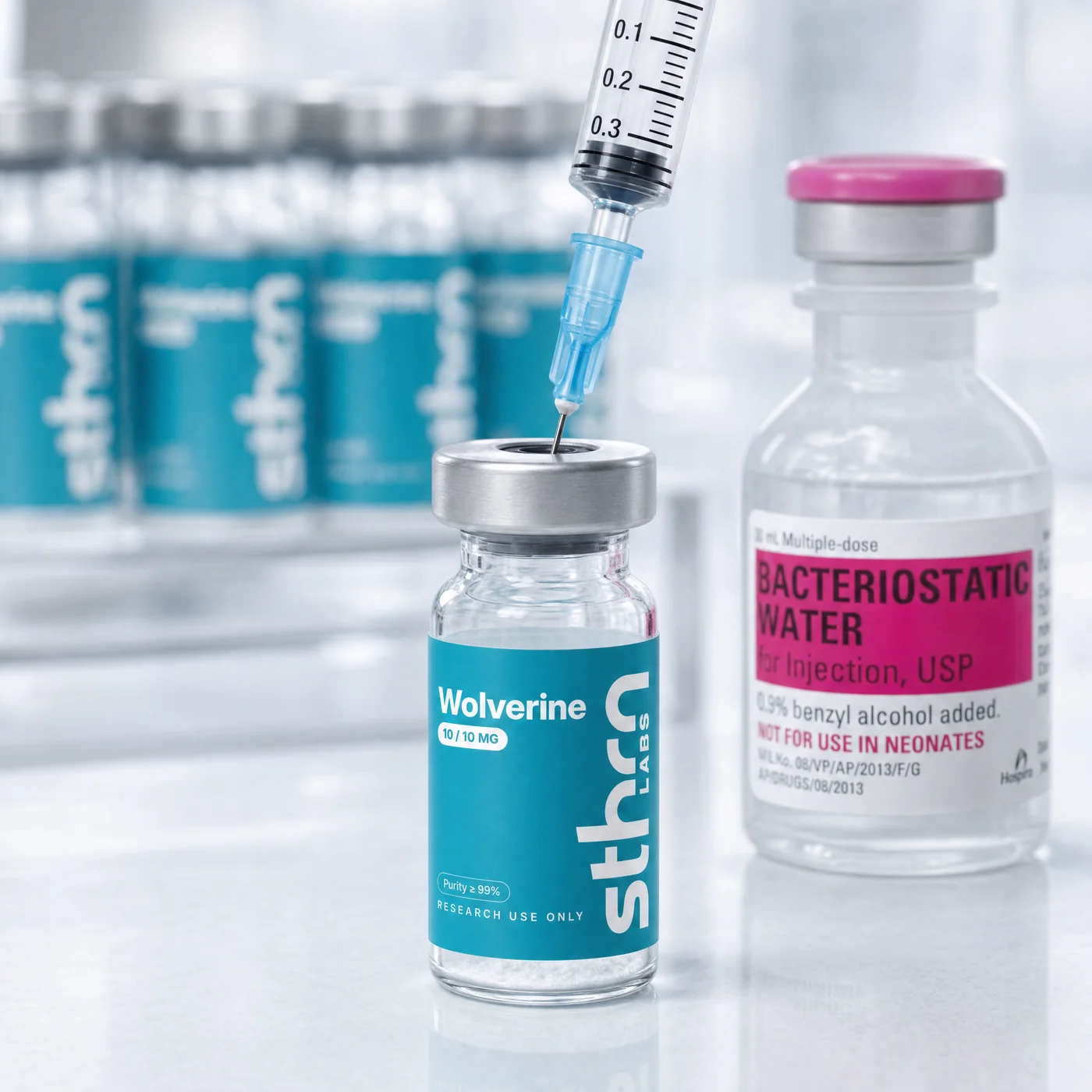
Choosing the right diluent
The diluent you pick directly affects stability and solubility.
Sterile water with 0.9% benzyl alcohol as a preservative. Ideal for multi-draw vials; avoid with peptides sensitive to benzyl alcohol.
Isotonic saline that mimics physiological conditions. A good general-purpose diluent for single-use preparations.
Maintain a defined pH range. Choose based on the peptide's isoelectric point and the demands of your assay.
Typically 0.1–10% acetic acid in water. Useful for peptides with poor solubility in neutral-pH water.
Best practices
Wear gloves throughout handling to prevent contamination and degradation.
Let the vial reach room temperature before opening to avoid condensation.
Add diluent slowly down the vial wall — never directly onto the powder — to prevent foaming.
Swirl gently, don't shake. Vigorous shaking foams and degrades the peptide.
Warm difficult peptides gently (30–40°C); avoid prolonged sonication.
Aliquot into single-use volumes to avoid repeated freeze–thaw cycles.
Label and date every vial with peptide name, concentration, diluent, and storage conditions.
Storing reconstituted peptides
Temperatures below are for reconstituted solutions — not sealed lyophilized vials, which store at −20°C long-term.
Common mistakes
Miscalculating concentration, leading to inaccurate dosing.
Using a diluent that's wrong for the peptide.
Shaking vigorously and foaming the solution.
Ignoring temperature during reconstitution.
Repeated freeze–thaw cycles that degrade the peptide.
Using contaminated diluents or non-sterile technique.
Frequently asked questions
Ready when your research is.
Every batch third-party tested, 99%+ purity, COA available for every product.
Shop compounds